The complete guide to resume optimization: How to tailor your resume for any job (2026)
1. What is resume optimization?
Resume optimization is the process of adjusting your resume based on the specific role you're applying for so both ATS and humans see you as a match.
The goal isn't to game the system. It's to improve your odds of being considered for a role you're qualified for by making sure your resume hits all the important points and keywords. So when you adjust your resume to match a given job description, you're really just surfacing your most relevant experience in an interview-defensible way.
2. Why it matters in 2026
ATS acts as a filter for hiring managers by scanning candidate resumes for the most relevant ones for a given role. It's a gatekeeper to streamline the hiring process, and if you've ever been the hiring manager for a role, you know how many spam applications each job listing receives. (I experienced this first-hand at Business Insider, where every role that I hired for had hundreds of applicants, a good portion of which clearly didn't even look at the job description before submitting their resume.)
Here's the thing: The system isn't perfect. Even if you are a qualified candidate, if that's not clearly reflected in the terms and skills listed on your resume, ATS may filter you out. That's why it's so important to match your resume to the job you're applying for, so your credentials don't get lost in translation.
How to tailor your resume for any job
Step 1: Decode the job description
Before you apply for a job, you need to dissect the job description. Not only does this tell you exactly what the hiring manager is looking for in a successful candidate, but it also provides a roadmap for the most important skills and experience to highlight in your tailored resume.
For every job description, you'll want to identify the following:
- Core competencies: The specific skills a job requires
- Nice-to-haves: Maybe the hiring manager would prefer you had an advanced degree in psycholinguistics but realizes that might be asking a lot
- Dealbreakers: The must-haves, which can include minimum years of experience or willingness to relocate for a role
Once you have a clear understanding of the job description and the most important skills and experience mentioned in it, it's time to map that to the specific words you use in your resume.
This isn't a time to get creative; if a job description lists "SEO leadership and strategy" as a core responsibility, you'll want to use that exact wording on your resume. The closer you stick to the keywords used in the job description, the better chance you'll generally have at passing the ATS filters meant to look for those particular keywords.
Even if you parse a resume carefully, it's easy to accidentally overlook an important competency or skill. Using tools such as AI can help ensure you're not missing anything. Just paste in your job description and ask the LLM to identify the most important competencies.
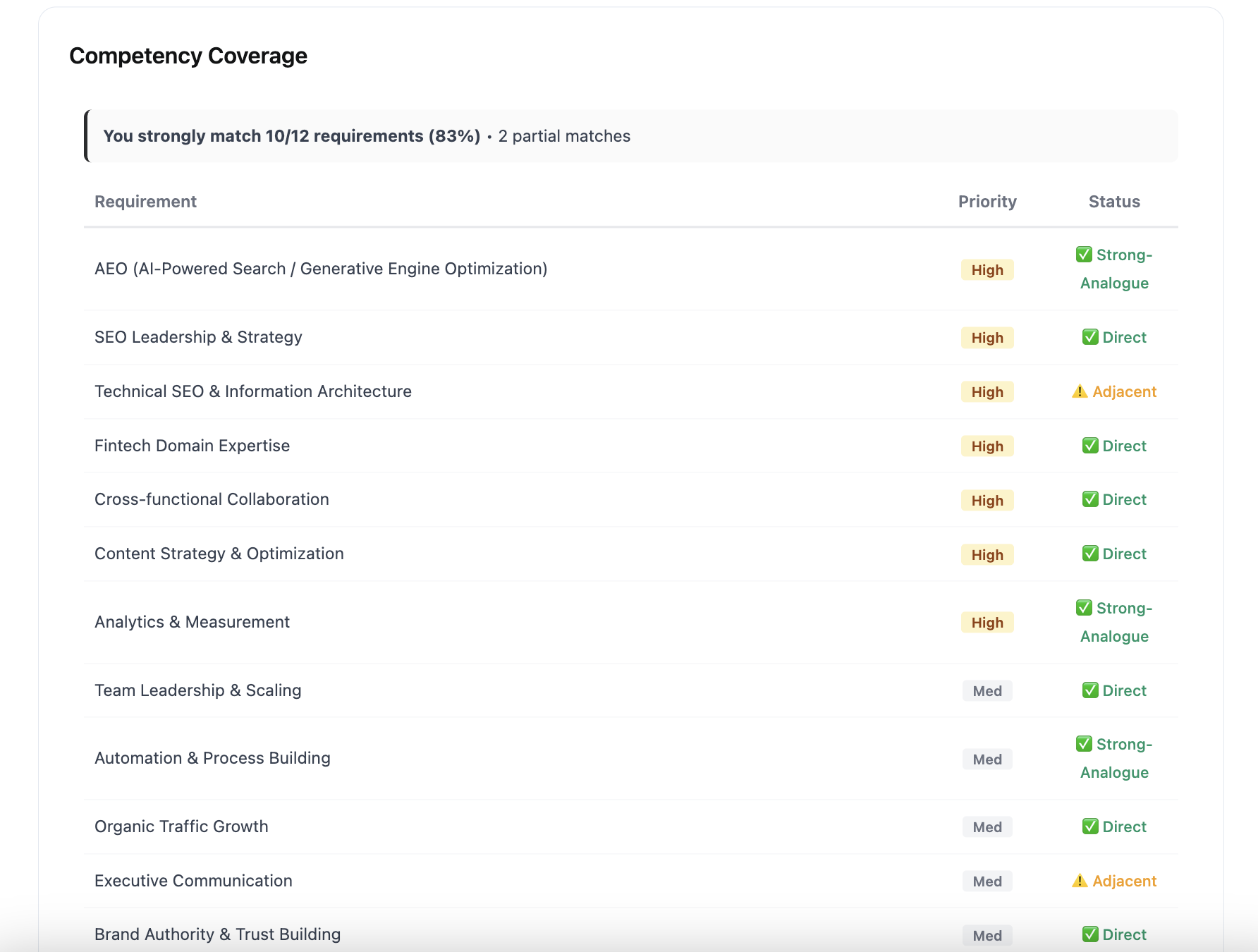
This is also one way that Notch Resume can help you optimize your resume. When you paste in a job description along with your existing resume, Notch will return an in-depth analysis of the core competencies of the job and which ones your resume matches. This list makes it easy to spot any key areas that are missing, so you can evaluate whether you have experience and skills worth adding or if you need to think about how to address any gaps in your cover letter.
Step 2: Rewrite your bullets for impact
Once you know the most important skills and competencies to address, you can start tweaking your resume bullets accordingly. (For a deep dive on this, see our guide on how to write resume bullet points that show impact.)
Stick with the same vocabulary used in the job description, and for each resume bullet, lead with the outcomes of your work rather than just rehashing your responsibilities.
For example, say you're an editor with years of experience leading a team. Instead of including a bullet that says "managed and coordinated team of 10 writers and editors across time zones," emphasize the results of your leadership. That could look like "managed a 10-person editorial team during a period where traffic and revenue grew by 80%."
Remember to keep everything on your resume interview-defensible. Don't invent skills or experiences you don't have. You don't want to end up in an interview and get asked about something you truly can't speak to. If you don't have a given skill mentioned in the job description, it's a better bet to find a bridge skill or experience that connects to what the role requires. If a role involves "executive communication," for instance, maybe you've never directly handled correspondence and messaging for a corporate leader, but if you've worked across teams to keep company leadership in the loop on important projects, you could mention "led cross-team collaboration for a key revenue-driving project, including coordinating meetings with C-Suite stakeholders."
For each bullet point, you'll want to be as specific as you can possibly get. Which leads us to the next point…
Step 3: Quantify your achievements
Whenever possible, you'll want to quantify your skills and impact on your resume. This connects back to that concept of focusing on outcomes rather than responsibilities. Hiring managers are looking for people who can deliver results, so any indication you can provide that you've driven meaningful growth will help you.
Examples of metrics to include:
- Revenue growth
- Traffic growth
- Search ranking wins
- Any numbers attached to volume of work completed or productivity
What if you don't have any obvious metrics to include? Don't panic; just take a step back and ask yourself why what you did mattered (the "so what?" test). Your work likely had some measurable impact, whether it's how often something got accomplished, how many customers or key stakeholders were affected, or how the scope and frequency of your work changed.
Step 4: Handle career pivots and gaps
What if you're in the middle of a career transition, applying for jobs that are outside of your previous realm of experience? How do you strike a good balance between addressing what the job description is looking for and staying honest?
The key is mapping your experience to the competencies in the job description. Even if you don't have experience working on social media campaigns, for example, if you've done anything that relates to how customers find your product across platforms, you've likely used some of the same skills.
Wherever possible, show how your existing skills bridge to the requirements of the role you're applying for. But for things that you flat-out don't have any experience doing — like using a specific software or a particular technical certification — you're best off leaving those off completely.
Step 5: Format for ATS and humans
When it comes to resume formatting, less is not only more; it's essential to your success. ATS doesn't parse complicated elements like tables, columns, or footers well, so keep your resume to simple bullet points without extra bells and whistles. (For more on this, see our guide on how ATS works for resumes.)
Make sure you save your resume in the file format specified by the job posting (the most common types are .pdf and .docx).
Finally, make sure your resume is scannable. That means no dense paragraphs. Hiring managers are looking at hundreds of resumes, so your key qualifications need to be immediately apparent to them when they come to yours.
Step 6: Audit before you submit
Before you finalize your job application and hit submit, check for common resume red flags recruiters notice immediately and run through the following resume checklist:
- Confirm that every resume bullet point maps to a job description requirement
- Ensure all your resume bullets are accurate and interview-defensible
- Double-check your contact info
- Save your resume with a professional file name (YOURNAME-JOBTITLE-RESUME is a popular format to follow)
- Preview your resume after saving it in its given file format to make sure no formatting weirdness pops up
How AI tools fit in (and their limits)
ChatGPT, Gemini, Claude, Copilot — whatever your AI of choice is, it can be a worthwhile tool in analyzing your resume against a job description and flagging any gaps between the two. AI can also help synthesize information from a long job description to give you a top-level view of the most important skills you need to highlight.
However, it's usually not wise to hand over the reins to AI completely. Risks of relying on it to rewrite your resume entirely include:
- Invented skills or experience that you won't be able to back up in a job interview
- Over-optimization, where your resume reads like keyword salad
- No clear narrative that positions you, the job-seeker, as a human with an interesting career arc and set of skills
You can strike a healthy balance by using AI to help optimize your resume for a job description as long as you don't take all of its recommendations for granted without evaluating them critically first.
AI-powered resume tools, such as Notch, can also help you stay honest and grounded. The benefit of Notch is that you can view your overall job match score and see how adjusting resume bullets would change it. Notch also lets you copy and paste specific bullet variants, so you can adjust your resume on a micro level rather than completely overhauling it with a vague sense of "making it better."
Improve your resume now
You have the framework. Now it's time to try it on your actual resume. Use Notch to get an ATS-optimized resume tailored to any job description in minutes.
Analyze my resumeFrequently asked questions
How long does it take to tailor a resume?
Tailoring a resume doesn't have to take long. You just need to identify the most important skills and competencies in your target job description and make sure those are reflected across your resume bullets. Once you're familiar with the process, it can take as little as 10-20 minutes to adjust your resume for a specific job description.
Should I tailor my resume for every job?
Yes, you should tailor your resume for every job you apply for, but this doesn't mean writing your resume from scratch each time. Beyond adjusting resume bullets to reflect the most important requirements of a job, you may want to adjust the top of your resume if you have a header line that positions your career experience overall.
Can ATS reject my resume?
Yes, ATS can effectively reject your resume if it filters you out because you're missing keywords or you miss basic requirements of the role. If your resume has complicated formatting, ATS may not be able to read your bullets, in which case you could also be filtered out.
Is it okay to use AI to optimize my resume?
Yes, it's okay to use AI to optimize your resume. It can be helpful in identifying the most important skills in a job description and flagging areas that your current resume doesn't address. The key is to use AI thoughtfully; you should always be the final judge of whether its rewrites make sense. And keep a careful eye out to make sure AI doesn't invent job experiences or metrics that you can't actually back up in an interview.
Related Resources
- How to Tailor Your Resume to a Job Description: Step-by-Step Guide
- How ATS Works for Resumes — What applicant tracking systems actually do and what's worth optimizing
- Career Change Resume Guide: How to Translate Non-Traditional Experience
- How to write resume bullet points that show impact — Even without metrics
- Resume red flags recruiters notice in 6 seconds — 10 things that create doubt and how to fix them
- Resume keywords: how to find them and where to put them — Keyword strategy for ATS and recruiters